What happens when the life you’ve built can no longer hold you, or when someone else’s life can’t hold you the way you hoped it would?
To start over is to feel the grief of what might have been acutely and painfully, to sit with it for a while, and then somehow continue moving anyway. There is no choice, only forward.
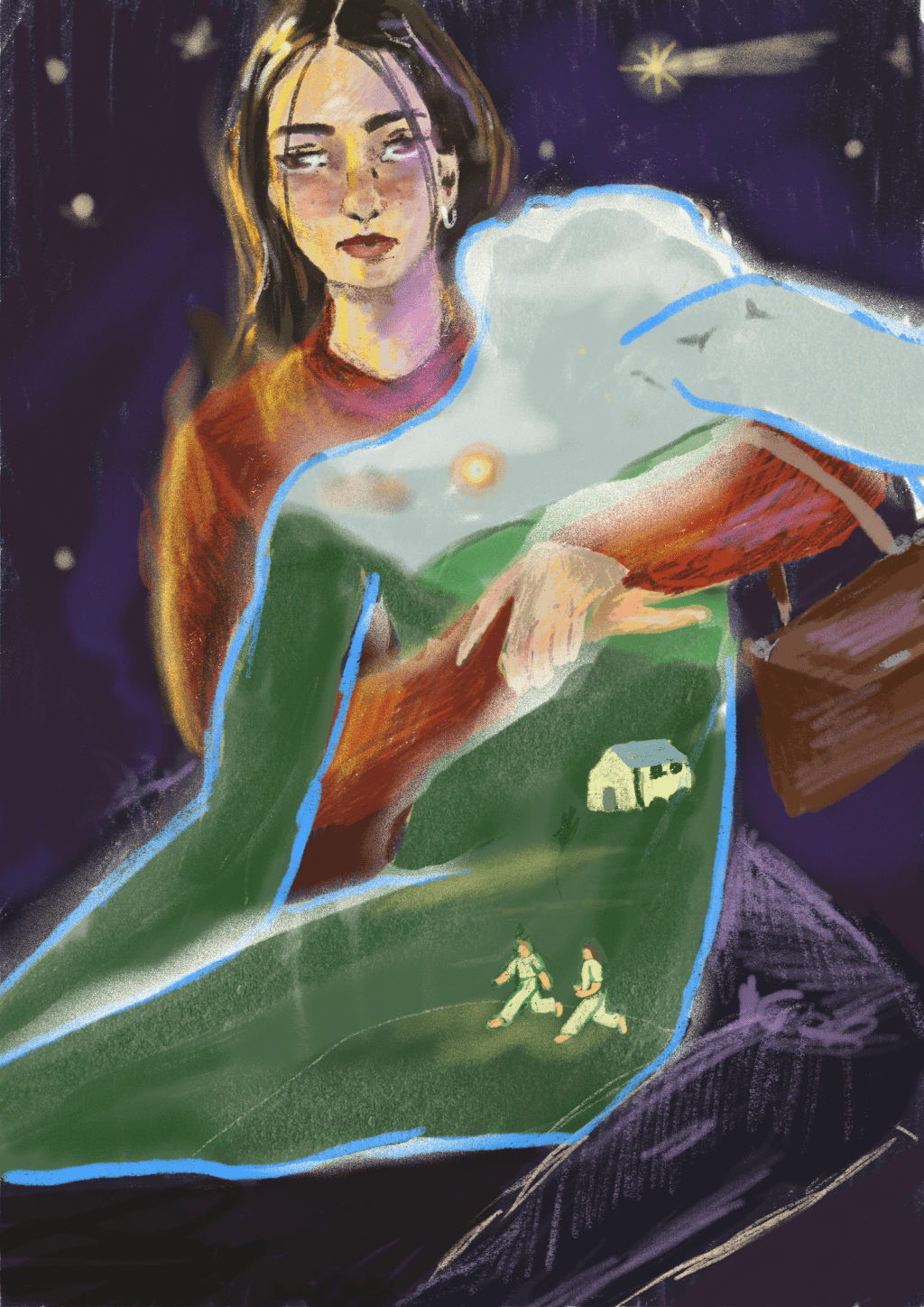
Lately I’ve been thinking about emotional capacity the way I think about a handbag. I keep mine close. Inside are the things I might need just in case: lipstick, crinkled receipts that somehow feel worth keeping, hand lotion, little comforts that make me feel prepared. Sometimes it’s a big handbag. There is room for my own life and someone else’s too. I can throw in another person’s keys, their sweater, their worries, and still carry my own without noticing the weight. But sometimes, sadly, you or other people only have their back pockets. They can carry their ID and maybe their phone, but there simply isn’t room for your things as well. It doesn’t mean they don’t love you. Sometimes it just means they’re already carrying everything they can.
What I’m getting at is that I’m heartbroken and starting over again. My purse has been emptied. There is a strange freedom that comes with that, but also grief, pain, and the ever-present confusion that follows drastic change in a short amount of time. Empty feels a lot like failure at first. You spend so long measuring your life by everything you’ve managed to carry that when your hands are suddenly free, it feels less like relief and more like loss. Only later do you realize that an empty bag is also an invitation. For the first time in years, you get to choose what goes back inside.
I recently quit my corporate job. I think I was good at it. I was trusted with a shocking amount of responsibility and was lucky to be in the position I was in. It paid well. From the outside, it looked like I had arrived. I had the title, the salary, the city life, and all the markers of the version of success I had spent years working toward. But I had also been carrying a corporate identity that no longer fit me, impossible expectations, and leadership that seemed determined to make every day feel heavier than the last. By the time I left, it felt like the straps on my handbag had been quietly stretching for years. They hadn’t snapped all at once; they had simply reached the point where they could no longer carry the weight.
I will soon be starting a new role as an Associate Art Curator in Oakland for a company I am genuinely excited about, making roughly half of what I was before. Leaving was terrifying because I quit with nothing lined up. After my last day, I only had four days of uncertainty before receiving two job offers, which I know, objectively, is something I should feel incredibly proud of. But I think we have a tendency to rewrite difficult moments into neat success stories once they’ve worked out. Those four days didn’t feel inspiring while I was living them. They felt frightening. It wasn’t just the uncertainty of finding another job; it was the uncertainty of who I would be if I wasn’t a graphic designer anymore. For the first time in years, my bag felt unexpectedly empty. I had spent so long carrying one version of myself that I mistook setting it down for losing it entirely.
This was the first time in my life I can remember being truly terrified of jumping. Even as a child, I was what most people would have called fearless. I threw myself toward experiences that I knew would shake me because they also forced me to grow. Every difficult thing I survived became evidence that I could survive the next one. Like a muscle, my confidence strengthened every time I landed on the other side of something hard. I trusted that if I needed to reinvent myself, I would figure it out because I always had before.
This time was different.
I had grown to love the stability I had built for myself. I had the apartment, the job, the routines, the city life. I wasn’t just leaving a career; I was questioning the life that career had been quietly constructing around me.
It felt like I had reached the end of a long hallway I had been barreling toward for years, only to discover that I wasn’t entirely sure I wanted what was waiting at the end of it. Sometimes we become so focused on carrying a life that we never stop to ask whether it still fits in our hands.
One thing I did know was that I wanted to be in my relationship. He was (and is) a good guy. My family loved him, my friends loved him, and he was also a designer, which meant there was a shorthand between us that I cherished. We met at work. We shared hobbies. We had been together for over a year and a half. From the outside, we looked like one of those couples people quietly assume will end up together, and if I’m honest, I assumed that too.
We went to trivia every Wednesday. Thursdays were date nights. Saturdays usually became little day trips somewhere outside the city. Those routines became a safe haven while the rest of my life felt increasingly uncertain. As my career shifted beneath me, our relationship became the one place I thought I could set my bag down for a while.
I remember thinking, Please don’t let me drown in these waters. He’ll be my lifeboat the way I’ve been his.
I had sheltered him, supported him, loved him, and would have done just about anything for him. When he quit his job, I came over at a moment’s notice. I helped him clean his room when everything felt like too much. I sat beside him through insecurities that neither of us could solve overnight. I never kept score because that wasn’t what love meant to me. Love, as I understood it, was simply taking turns carrying the weight.
So when my own life began unraveling, I didn’t expect him to fix it. I just wanted somewhere to rest for a little while.
It took me a long time to realize that I kept handing him pieces of my life to hold—not because I wanted him to solve them, but because that’s what partnership had always meant to me. I had carried his things before without hesitation, so I assumed he would naturally do the same when it was my turn. It wasn’t until much later that I understood he wasn’t refusing to carry my things; his own bag was already overflowing. That realization doesn’t erase the hurt, but it changes the shape of it. Rejection and limitation are not always the same thing.
I was raised by romantics, and a part of me still believes that if two people truly love each other, that should be enough. That with love, you show up. You stay. You keep choosing one another. That by simply holding hands, two people can weather almost any storm.
But I’ve started to think there are different kinds of love. There is love as a feeling, and then there is love as an action—as a practice, as a choice you continue making long after the feeling has become complicated. That kind of love depends not only on desire but on capacity. On how much room someone has left in their bag after carrying their own fears, insecurities, grief, and expectations. Sometimes love is there, quietly and genuinely, but the capacity isn’t. Sometimes someone can love you deeply and still be unable to hold you because they’re struggling just to hold themselves.
That was the part that broke my heart.
All I wanted was someone to weather the storm beside me. I didn’t need him to rescue me. I just wanted to know that when the water got high, we would keep swimming in the same direction. But somehow, the more I reached toward him, the more he withdrew into himself. I couldn’t understand it. No matter how carefully I explained what I needed, no matter how gently I tried to ask for comfort instead of solutions, my love seemed to become another thing he felt responsible for carrying. The more tightly I held on, the further away he drifted.
I sacrificed. I compromised. I believed, maybe stubbornly, that if I just loved hard enough, communicated clearly enough, or waited patiently enough, we would eventually find our way back to one another. I had already begun furnishing the future in my mind. We would make it to the end of the hallway together. We’d get married, have a child, build a life, and grow into the people we were becoming alongside one another.
I didn’t realize that somewhere along the way, I was still carrying that future by myself.
A few nights after I accepted the new job, a friend was in town. They ended up staying with another friend because Thursday was our standing date night, as it always was. Before we went out, I had asked him if he could bring me flowers. Looking back, it feels almost embarrassingly small. We didn’t have to move in together. We didn’t have to make any big decisions about our future. I wasn’t asking for certainty. I think I was asking for evidence. I think I was simply asking him to show up for me in a tangible way during a season where everything else felt uncertain. Just this once, I wanted to feel chosen.
He didn’t bring the flowers.
I remember telling myself it didn’t matter because he was still taking me out to celebrate my new job, and I was genuinely excited. We had dinner, talked, laughed, and for a little while I convinced myself that maybe I had simply been anxious for nothing and been apologizing for that fear too.
Then we came home.I could feel there was something happening inside him, some quiet struggle I couldn’t name, but even then I wasn’t prepared for the conversation that followed. I could feel something happening inside him, some quiet struggle I couldn’t name. Even then, I wasn’t prepared for the conversation that followed. Over the next hour, my greatest fear at the time became reality. The lifeboat I had imagined climbing into quietly drifted away. He broke up with me. He told me he loved me, and then he left.
He hasn’t spoken a word to me since.
Even the smallest things changed overnight. His mom unfollowed me. Friends who had once felt like extensions of our shared life became strangers, choosing silence over acknowledgment. Suddenly I wasn’t just grieving the relationship; I was grieving the entire life I had been building around it. The routines. The imagined future. The ordinary little rituals that had quietly become home.
It felt as though someone had emptied my handbag onto the floor.
Everything I had been carefully collecting over the last two years was suddenly scattered in front of me: our inside jokes, the shows we’ll never finish, the trips we’ll never take, remembering to remind each other to take our medication, asking him to put air in my tires because I hated to do it, grocery lists, Thursday nights, Saturday mornings, all the tiny domestic moments that never seem important while you’re living them. They had become woven so tightly into my everyday life that I hadn’t realized I was carrying them until they were gone.
I wrote him a letter shortly afterward and poured everything I had left to say into it. I still catch myself checking the mailbox every now and then, hoping that closure might arrive folded inside an envelope. It never has.
For a long time, I tried to understand how someone could love me and still leave. Eventually, I stopped asking whether he had rejected me and started wondering if perhaps he had rejected the version of himself he believed I needed him to be. I honestly hope that when he walked away, he believed it was the kindest thing he could do. None of those hopes change what happened.They simply allow me to carry the memory with a little less bitterness.
Sometimes the universe puts periods on sentences we are too weak to end on our own.
The point of writing this isn’t simply to wail out my own pain—although, admittedly, maybe a little. It’s also to say that if you are living through a season where everything feels uncertain, you are not alone. More than anything, this has become an attempt to understand how healing happens after the life you imagined quietly disappears.
Slowly, I’ve started choosing what deserves space in the bag again. Photography. Friends. Long walks. New work. Curiosity. Saying yes more often. There is something strangely joyful about realizing that after years of carrying what I thought I was supposed to, I finally get to pack for the life I actually want. There is something strangely joyful about realizing that after years of carrying what I thought I was supposed to, I finally get to choose what is actually mine.
Grief has a way of emptying your hands.
Healing, I’ve learned, is deciding what deserves to be picked back up.
It has also been the summer of learning to let go. Or maybe, more accurately, learning that letting go isn’t the same thing as loving less. I have been trying to trust that love and generosity are not finite resources, even when they come from within myself. I regret nothing about loving wholeheartedly. I would rather risk heartbreak than become someone who only ever offers half of herself in the name of self-protection. I’d rather feel everything than spend my life carefully avoiding disappointment.
I’ve been practicing doing the brave thing—not clutching everything so tightly to my chest, but opening my hands anyway. Giving freely. Trusting that if something isn’t meant for me, I don’t need to squeeze harder to make it stay. Grief also asks for witnesses.
Maybe that’s why I write. Maybe that’s why I make art. There is something profoundly healing about allowing your truth to exist outside of yourself, where someone else can quietly recognize a piece of their own life inside it. I think that is one of the greatest gifts we can give each other—not solutions, but recognition.
I know that I will be okay.
Not because everything worked out the way I hoped, but because I’ve started to trust myself again. There is no shortage of love within me, and I don’t believe there is a shortage of love waiting for me either.I refuse to become bitter. I refuse to mistake detachment for wisdom or nonchalance for healing. I am, unapologetically, a lover girl. I always have been. In a culture that often rewards irony, emotional distance, and pretending not to care, vulnerability can feel almost embarrassing. But I still think it’s worth it. I still think showing up wholeheartedly is one of the bravest things a person can do.
Partly because love and life is so, so, so hard.
In my first therapy session, I would sit across from her and say, “I’m not sure why, but everything just feels so hard. I’m exhausted. Nothing is filling my cup anymore.” Looking back, I don’t think there was anything wrong with me. I think I had simply been carrying too much for too long.
What I’ve learned is that grief and joy are not opposites. They are evidence of the same thing: that you allowed yourself to care. The willingness to fully experience one expands your capacity for the other. There is a certain elasticity that develops through loss. Your heart stretches, painfully at first, but when it heals it holds more than it did before. More compassion. More gratitude. More love. Maybe that’s what healing really is—not forgetting what you carried, but becoming strong enough to carry it differently.
I have been thinking about the story of Orpheus and Eurydice.
When I was younger, I thought Orpheus lacked discipline. If he had only waited a little longer, he could have had everything. Now I don’t think there was ever another ending available to him. To love Eurydice the way he did was always going to mean looking back. Some loves ask us to carry people long after they have disappeared from view. Perhaps that is the price of loving at all.
My bag is lighter now. Not emptier.
Just lighter.
And for the first time in a long time, I get to choose what comes with me next.
with love,
Julia


Leave a comment